

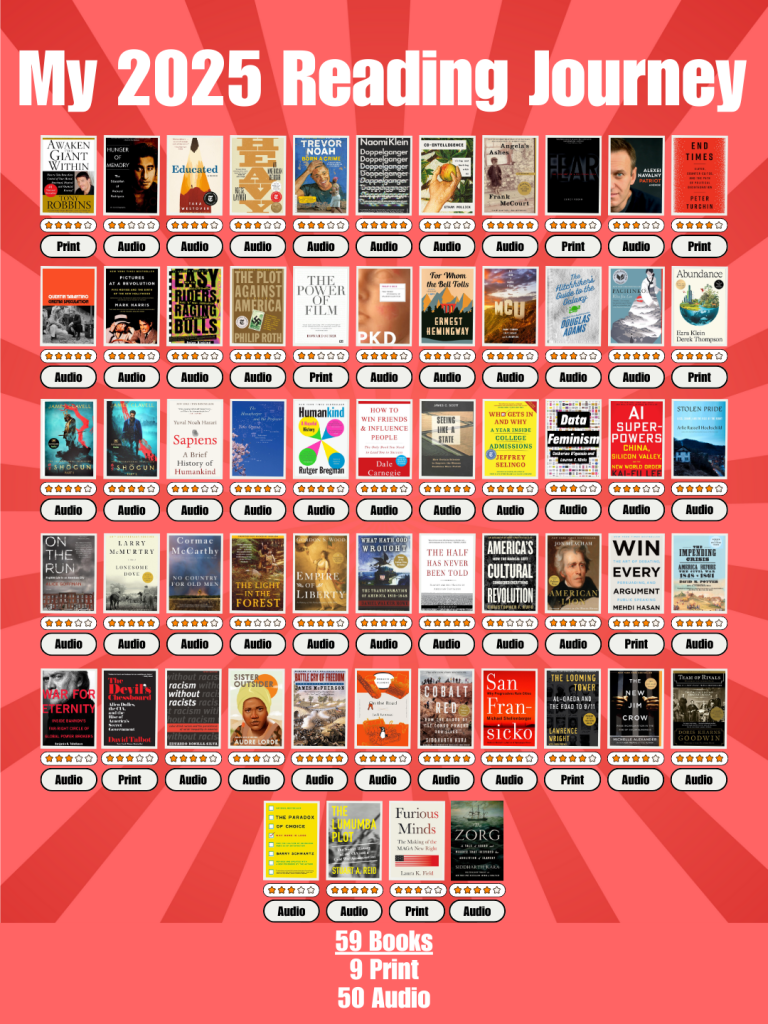
In 2025, I read 59 books, nine in print and fifty as audiobooks. I began the year focused on biographies, moved through historical fiction, and ended deep in American history. Along the way, I also read sociology, global history, current events, and a small amount of self-help.
The most consistent theme in my reading, however, was not a particular genre but debate. I made a deliberate effort to read across perspectives, especially ideas I disagree with, rather than limiting myself to books that simply reinforce what I already believe. For me, reading is not just about enjoyment or information, but about testing assumptions, sharpening arguments, and better understanding the people and ideas I often find myself in conversation or disagreement with.
With that said, here are the books I read and my thoughts on them.
Awaken the Giant Within: How to Take Immediate Control of Your Mental, Emotional, Physical, and Financial Destiny
By Tony Robbins
Print | ⭐⭐⭐⭐☆ (4 out of 5)
This was a strong way to start the year. While I have read plenty of self-help over the years, I had never really engaged with Tony Robbins. I think part of that resistance came from always associating him with Patrick Swayze’s character in Donnie Darko. That said, this book surprised me.
My biggest takeaway, though seemingly simple, is the idea that lasting change requires a shift in identity, not just behavior. If you want to work out, the goal is not merely thirty minutes a day, but seeing yourself as someone who works out. That framing stuck with me. Like most self-help books, however, it is far longer than it needs to be for what it ultimately offers.
Hunger of Memory: The Education of Richard Rodriguez
By Richard Rodriguez
Audio | ⭐⭐⭐☆☆ (3 out of 5)
I knew going into the year that I wanted to focus on memoirs, and this felt like an intentional place to start. I was already familiar with Rodriguez as a controversial figure, particularly because of his views on affirmative action, but I also strongly identified with his experience as a first-generation college student.
Each chapter stands on its own, which is both a strength and a weakness. Some sections, especially those focused on higher education, resonated deeply with me. Others, particularly the chapters on language and religion, were far less compelling. I appreciated the honesty of the work, even when I disagreed with its conclusions.
Educated: A Memoir
Tara Westover
Audio | ⭐⭐⭐⭐☆ (4 out of 5)
This book had been sitting in my library for years before I finally picked it up, and I am glad I did. Westover’s story is engaging and often unsettling. At times, it feels almost unbelievable, but it never loses its emotional weight.
What stood out most to me was the way education is framed not simply as a path to employment, but as a lifelong process of self-formation. That perspective strongly resonated with my own experience as a learner and educator.
Heavy: An American Memoir
Kiese Laymon
Audio | ⭐⭐⭐☆☆ (3 out of 5)
I really wanted to love this book, and there is a lot here to admire. Laymon is an exceptionally talented writer who is unafraid to tell the truth as he sees it, even when that truth casts himself or others in an unflattering light.
That honesty, however, also makes the narrative difficult to sit with. I found it hard to sympathize not only with the people in his life, but at times with Laymon himself. By the end, I was left feeling more despair than reflection or inspiration, which made the experience uneven for me despite the strength of the prose.
Born a Crime: Stories from a South African Childhood
Trevor Noah
Audio | ⭐⭐⭐☆☆ (3 out of 5)
I was really looking forward to this book. I regularly watch The Daily Show and have seen Noah’s stand-up, so my expectations were high. While I liked the book, I did not love it.
That said, Noah does an excellent job telling engaging stories and translating the experience of growing up in South Africa in a way that is accessible to an American audience. It is entertaining and informative, even if it did not fully land for me on a deeper level.
Doppelganger: A Trip into the Mirror World
Naomi Klein
Audio | ⭐⭐⭐⭐⭐ (5 out of 5)
I have long admired Naomi Klein’s work, but I went into this book unsure of what to expect. I was not even entirely sure what it was about. By the end, I loved it.
This book moves across genres and topics with surprising agility, weaving together political analysis, cultural critique, and personal reflection. It takes several unexpected turns, yet never feels scattered. I finished it with a much clearer sense of the social and political moment we are currently living in. This was one of the most intellectually satisfying reads of my year.
Co-Intelligence: The Definitive, Bestselling Guide to Living and Working With AI
Ethan Mollick
Audio | ⭐⭐☆☆☆ (2 out of 5)
This book was fine. If you are new to working with AI, it will likely feel eye-opening and useful. If, however, you have been using AI with any regularity, there is not much here that feels new or particularly challenging. Much of the content reinforces ideas that are already widely circulating, which made the experience feel more introductory than definitive.
Angela’s Ashes: A Memoir
Frank McCourt
Audio | ⭐⭐⭐⭐⭐ (5 out of 5)
I remember when both the book and the film were released, and this is something I had always meant to read. When I finally did, it did not disappoint. McCourt explores themes of poverty, addiction, abandonment, and trauma through the lens of his childhood self, blending harshness with innocence, sympathy, and humor.
What stood out most was his voice and his ability to fully inhabit his younger self without sentimentality. The only drawback was the somewhat abrupt ending, which left me wanting more. In that sense, it succeeded in pushing me directly toward his other two books. I would absolutely recommend this.
Fear: The History of an Idea
Corey Robin
Print | ⭐⭐⭐⭐☆ (4 out of 5)
Written in the post-9/11 moment, this book remains strikingly relevant more than twenty years later, if not even more so now. While parts of the text are dense and assume some background knowledge in political theory, it offers a powerful framework for understanding fear as a central organizing force in the modern liberal order.
Robin shows how fear operates not merely as an emotion, but as a political tool used to justify authority, discipline populations, and shape public life. It is demanding at times, but well worth the effort.
Patriot: A Memoir
Alexei Navalny
Audio | ⭐⭐⭐⭐☆ (4 out of 5)
This book is divided into two parts: Navalny’s life and activism before imprisonment, and his prison writings leading up to his death. That structure feels unplanned, largely because history intervened. What begins as a story centered on Navalny’s poisoning and return to Russia quickly becomes a record of imprisonment and ultimate death.
The book is not important because of its prose, but because of Navalny himself. It captures what it means to resist authoritarian power and the personal cost of doing so. In that sense, I would consider it less a literary achievement than a moral and political document, as well as symbol of resistance.
End Times: Elites, Counter-Elites, and the Path of Political Disintegration
Peter Turchin
Print | ⭐⭐⭐⭐☆ (4 out of 5)
I am consistently drawn to large-scale, long-term historical sociology, and this book delivered on that front. Using extensive datasets, Turchin examines patterns in the rise and fall of societies, focusing on moments when economic immiseration coincides with elite overproduction.
His core argument is that societies become unstable when stagnant wages and rising inequality collide with a growing number of people competing for elite status with too few pathways available. Although the book is historical, the shadow of the present-day United States is never far from view.
Cinema Speculation
Quentin Tarantino
Audio | ⭐⭐⭐⭐☆ (4 out of 5)
I loved this book not because of its structure or prose, but because of Tarantino’s sheer enthusiasm. His love of movies pours through every page, and it is contagious.
Reading this immediately sent me back to the films he references, and I found myself doing a deep dive into the New Hollywood era alongside him. The book works less as criticism and more as an invitation to watch, rewatch, and care deeply about cinema.
Pictures at a Revolution: Five Movies and the Birth of New Hollywood
Mark Harris
Audio | ⭐⭐⭐⭐☆ (4 out of 5)
This book was excellent. Harris centers the story on the five films nominated for Best Picture in 1968 and argues that this moment represented not just a turning point in Hollywood, but a broader cultural shift. The book captures the rise of New Hollywood, inspired by the French New Wave, through films like Bonnie and Clyde and The Graduate, while also chronicling the decline of Old Hollywood, symbolized most clearly by the Doctor Dolittle fiasco.
What makes the book work so well is how tightly it connects industry change to larger social transformation. The Oscars become a lens for understanding a moment when the old rules were no longer holding, and something new was being born.
Easy Riders, Raging Bulls: How the Sex-Drugs-and-Rock ‘N’ Roll Generation Saved Hollywood
Peter Biskind
Audio | ⭐⭐⭐☆☆ (3 out of 5)
I first read this book about twenty years ago and still think it is an engaging read. Biskind is less interested in producing a careful, archival history of New Hollywood and more focused on building a larger-than-life mythology around it.
The result is often salacious, sometimes exaggerated, and occasionally unreliable, but also undeniably entertaining. It captures the excess, ego, and chaos of the era better than it captures its structural foundations. I considered it more tabloid than a serious analysis of the period..
The Plot Against America
Philip Roth
Audio | ⭐⭐⭐⭐☆ (4 out of 5)
After watching David Chase’s miniseries a few years ago and loving it, I decided to finally read the novel. Like Chase’s adaptation, this work of historical fiction is compelling and unsettling.
Roth imagines an alternate United States in which the celebrity Nazi sympathizer, Charles Lindbergh, defeats Franklin D. Roosevelt for the presidency. Running on a platform of peace and staying out of World War II, we see how Lindeburgh’s America quickly devolves into an America First authoritarianism built on anti-Semitism, conspiracy, spectacle, violence, and suppression. The parallels to the present moment are difficult to ignore, which gives the story much of its power.
The Power of Film
Howard Suber
Print | ⭐⭐☆☆☆ (2 out of 5)
I watched the HBO documentary series and found it excellent. The book itself, however, did not work as well for me. It functions more as a reference text than a sustained narrative, which made it difficult to read straight through.
While many of the insights are sharp and illuminating, the format kept me from fully engaging with it as a book rather than a resource.
The Three Stigmata of Palmer Eldritch
Philip K. Dick
Audio | ⭐⭐⭐⭐☆ (4 out of 5)
I have yet to read a Philip K. Dick novel that I did not enjoy, and this one was no exception. The story is filled with environmental collapse, interplanetary colonies, and galactic drug dealers.
Beneath the science fiction, the book wrestles with questions of reality and religion, filtered through corporatization and commodification. The book is strange, unsettling, and very much on brand for Philip K. Dick.
For Whom the Bell Tolls
Ernest Hemingway
Audio | ⭐⭐⭐☆☆ (3 out of 5)
I wanted to love this book more than I did. It follows an American volunteer, Robert Jordan, in the Spanish Civil War, who joins a group of Spanish anti-fascist guerrillas fighting against General Franco’s army in a mission to blow up a bridge.
While the novel presents the themes of idealism, duty, and sacrifice, the heart of it lies is with the internal tensions within the guerrilla group stemming from the varied reasons they joined the resistance.
Despite all of this, and despite the urgent nature of Jordan’s mission, the pacing is slow, and it seems to be just one interrupted conversation after another, which ultimately limited my engagement to the story.
MCU: The Reign of Marvel Studios
Joanna Robinson, Dave Gonzalez, and Gavin Edwards
Audio | ⭐⭐⭐⭐☆ (4 out of 5)
I really enjoyed this book. It traces the history of the Marvel Cinematic Universe through Avengers: Endgame and does an excellent job explaining how Marvel went from repeated failures in the 1990s and early 2000s to becoming a cultural juggernaut after Iron Man in 2008.
What fascinated me most was how a once-independent studio managed to weave so many films into a single, unified narrative, creating a holistically new way of producing and consuming films. Reading it now, as Marvel’s momentum appears to be fading, makes both its rise and its unraveling even more interesting.
The Hitchhiker’s Guide to the Galaxy
Douglas Adams
Audio | ⭐⭐⭐☆☆ (3 out of 5)
I have read this book several times before and picked it up again looking for something short and fun. While it remains entertaining, this reread did not hit quite as hard as it had in the past.
That may say more about timing and familiarity than the book itself, but it felt lighter on impact than I remembered.
Pachinko
Min Jin Lee
Audio | ⭐⭐⭐⭐⭐ (5 out of 5)
I am a sucker for multi-generational family epics, and this book fully delivered. It follows Sunja’s journey from a poor fishing village in Korea to Japan during the early to mid-twentieth century, while also tracing the lives of her parents, children, and grandchildren.
What makes Pachinko so powerful is how it layers intimate family dynamics onto much larger geopolitical forces. Themes of gender, migration, and racial hierarchy, particularly the fraught relationship between Koreans and Japanese society, are woven seamlessly into the narrative. It is both deeply personal and structurally expansive, which is exactly what I look for in this kind of novel.
Abundance: How We Build a Better Future
Ezra Klein and Derek Thompson
Print | ⭐⭐⭐⭐☆ (4 out of 5)
One of the most common critiques of books on the political left is that they excel at diagnosing problems but struggle to offer concrete solutions. This book explicitly tries to reverse that pattern. While it falls short in places, I found myself rooting for it.
Each chapter focuses on a different issue, from housing in California to the structure of the scientific research industry, and attempts to identify real bottlenecks rather than abstract ideals. What I appreciated most is that the proposed solutions are not purely aspirational, but grounded in institutional and political realities that could be addressed with sufficient will and imagination.
That said, the book’s ambition outpaces its length. Given its broad scope, gaps are inevitable. In retrospect, especially considering Ezra Klein’s later debates with Ta-Nehisi Coates, the liberal vision outlined here can feel naïve or short-sighted at times. The book also suffered from timing, having been intended for release during the 2024 election cycle but arriving in early 2025, after its primary political audience had already experienced a decisive defeat.
Shōgun, Part One
James Clavell
Audio | ⭐⭐⭐⭐☆ (4 out of 5)
This book is long, so long that it is split into two parts. It follows John Blackthorne, an English ship pilot sailing on a Dutch trading expedition, who is shipwrecked with his surviving crew in feudal Japan.
The novel offers a politically rich and immersive portrayal of the period. While fictional, Clavell is meticulous in his historical detail, attempting to present an accurate, if inevitably Westernized, version of feudal Japanese society. The result is both engrossing and intellectually intriguing.
Shōgun, Part Two
James Clavell
Audio | ⭐⭐⭐⭐☆ (4 out of 5)
I moved directly from the first part into the second without hesitation. This section continues Blackthorne’s integration into Japanese society, particularly through his relationship with Lord Yoshii Toranaga and Mariko, his translator.
While the novel clearly functions as a fish-out-of-water story designed for a Western audience, it does more than simply exoticize its setting. Across both parts, the book works to build a bridge between cultures, showing how values like honor, loyalty, duty, and love can traverse deep cultural and political divides.
Sapiens: A Brief History of Humankind
Yuval Noah Harari
Audio | ⭐⭐⭐☆☆ (3 out of 5)
This book sits comfortably alongside other popular works of “big history,” such as those by Jared Diamond, that are widely read by general audiences and often received cautiously by academics. It is engaging, clearly written, and packed with provocative claims about human cooperation, mythmaking, and progress, which helps explain its broad appeal.
At the same time, Harari’s sweeping scope tends to flatten historical nuance by relying heavily on evolutionary narratives that resolve complex social and political debates too cleanly. Familiar ideas from anthropology and cognitive science are repackaged in ways that privilege long-term evolutionary “progress” over contingency, conflict, and historical rupture. In that sense, the book feels less like a product of the 2010s, with their renewed attention to power, institutions, and inequality, and more at home in the 1990s tradition of confident evolutionary storytelling. I enjoyed reading it and found it intellectually stimulating, but ultimately experienced it as more philosophical than genuinely historical, offering a compelling worldview rather than a sustained engagement with historical complexity.
The Housekeeper and the Professor
Yoko Ogawa
Audio | ⭐⭐⭐⭐☆ (4 out of 5)
This is a short but deeply affecting novel centered on a mathematics professor who, due to an accident, can retain only eighty minutes of short-term memory. The story unfolds through his relationship with his housekeeper and her young son.
At its core, the book is about communication and human connection. Bonds are built through routine, patience, and compassion, with mathematics serving as a shared language that transcends memory, age, and circumstance. Quiet, gentle, and thoughtful, it lingers well beyond its length.
Humankind: A Hopeful History
Rutger Bregman
Audio | ⭐⭐⭐⭐☆ (4 out of 5)
This book offers a deliberate counterpoint to the darker visions of human history presented by writers like Jared Diamond and Yuval Noah Harari (see above). Where those accounts often emphasize domination, hierarchy, and manipulation, Bregman builds a “big history” grounded in empathy, cooperation, and trust.
Drawing on a wide range of studies and historical cases, from the “true” Lord of the Flies to critiques of the Stanford Prison Experiment, Bregman makes a compelling argument that humans are far kinder and more cooperative than we are typically led to believe. Whether or not I accept all of his conclusions is yet to be determined, though I still thoroughly enjoyed his book.
How to Win Friends and Influence People
Dale Carnegie
Audio | ⭐⭐⭐⭐☆ (4 out of 5)
This is a reread, inspired in part by the television show Young Sheldon and its hilarious take on the power of remembering and using people’s names. As a sociologist, my instincts usually pull me toward structure rather than individual agency. Still, as a human being who struggles socially, I find this book genuinely helpful. While it is often framed as a guide to persuasion, it is really about building human connection while staying true to yourself. It is not about subtle manipulation so much as learning to treat people with respect, empathy, and sustained attention.
Much of the advice feels obvious on the surface, yet remains surprisingly difficult to practice consistently. That, I think, is why the book continues to hold up all these years later.
Seeing Like a State: How Certain Schemes to Improve the Human Condition Have Failed
James C. Scott
Audio | ⭐⭐⭐⭐⭐ (5 out of 5)
This was a reread from years ago, and it remains my favorite of Scott’s books. I spent a great deal of time with it in graduate school, where it shaped how I thought about power, planning, and the unintended consequences of well-meaning interventions. When I saw it available for free on Audible, I returned to it less for the details and more to re-engage with its larger arguments, and I found myself even more absorbed this time around.
Scott examines large-scale state-led projects that claim to improve the human condition but instead produce social and ecological disasters. His core argument is that these failures emerge from efforts to make complex realities legible through standardized systems designed for administration, taxation, and control. While all states engage in this kind of simplification to some degree, Scott shows why it so often collapses under the weight of lived complexity. What endures instead is mētis, the localized, experiential knowledge rooted in practice, place, and adaptation.
What struck me most on this reread is how much my own thinking has shifted. My work never focused exclusively on the state in Scott’s sense, but rather on capitalist ways of seeing, measuring, and rendering the world actionable. Read this way, Seeing Like a State sits comfortably alongside scholars such as Barbara Mundy, who examine how forms of knowledge actively reshape environments and societies into legible, governable, and ultimately exploitable forms. Revisiting the book now, it feels less like a critique of failed state planning alone and more like a foundational text for understanding how modern systems of domination, whether bureaucratic or market-driven, are built through vision itself.
Who Gets In and Why: A Year Inside College Admissions
Jeffrey Selingo
Audio | ⭐⭐⭐⭐☆ (4 out of 5)
If you are the parent of a college-bound high school student, this is close to required reading. Selingo pulls back the curtain on college admissions and shows how decisions that appear arbitrary are often driven by institutional priorities, market pressures, and resource constraints rather than individual merit alone.
What makes the book especially valuable is how clearly it distinguishes between different types of institutions and the vastly different logics they use to recruit, evaluate, and admit students. Selingo also situates modern admissions within a longer historical arc, dismantling the myth of a clean meritocracy and complicating popular narratives around race and gender. Who gets in, he shows, often depends less on any single achievement or identity and more on timing, strategy, and institutional need.
Data Feminism
Catherine D’Ignazio and Lauren F. Klein
Audio | ⭐⭐⭐☆☆ (3 out of 5)
I came to this book after a colleague recommended it in response to a critique she made of my own work. I had been building a fictional dataset for an imaginary university, Metricon University, and our conversation turned toward the social processes that underlie data collection. We talked at length about how datasets are rarely neutral artifacts, but are instead shaped by institutional priorities, power holders, and the questions deemed worth asking. At the same time, we also discussed how data can function as a tool of resistance when those processes are made visible and contested.
Read through that lens, Data Feminism is engaging and well researched, though it often feels closer to a polished academic dissertation than a disruptive intervention. Rather than carving out entirely new conceptual ground, the book frequently layers established feminist theory onto the emerging field of data science.
That said, D’Ignazio and Klein are at their strongest when challenging the persistent myth of data neutrality. They do important work unpacking how power operates through data systems, who collects data, who interprets it, and whose experiences are rendered invisible in the process. Their call to reimagine data practices around equity, care, and context is thoughtful and necessary, even if the book remains dense and firmly academic in tone throughout.
AI Superpowers: China, Silicon Valley, and the New World Order
Kai-Fu Lee
Audio | ⭐⭐⭐⭐☆ (4 out of 5)
I had mixed feelings about this book, and much of that stems from Lee’s positionality. He is not an academic, but a venture capitalist and former Google executive, and the book reflects that worldview. AI development is framed largely as a binary competition between China and the United States, with each positioned as a cultural and technological opposite.
Still, there is real insight here, particularly in Lee’s discussion of China’s research and development ecosystem, what he describes as “capitalism with Chinese characteristics.” His argument that the United States excels at conceptual innovation while China dominates in scaling and implementation struck me as persuasive. The book takes an unexpected and meaningful turn near the end, as Lee reflects on surviving cancer and rethinks success, AI, and work through the lens of compassion and human connection rather than productivity alone.
Stolen Pride: Loss, Shame, and the Rise of the Right
Arlie Russell Hochschild
Audio | ⭐⭐⭐⭐☆ (4 out of 5)
This book reads as a natural continuation of Strangers in Their Own Land, extending Hochschild’s earlier work on political estrangement into a more explicit analysis of emotion. In Stolen Pride, she frames the rise of Trump and the broader MAGA movement through three interlocking forces: loss, shame, and the search for restored pride.
What I found most compelling is how firmly she centers emotion as a driver of contemporary politics. Rather than explaining political alignment primarily through ideology, ignorance, or misinformation, Hochschild foregrounds questions of identity, dignity, and moral feeling. In doing so, she offers a more textured and humane way of understanding political mobilization, one that helps explain not just what people believe, but how they come to feel morally located in the world.
On the Run: Fugitive Life in an American City
Alice Goffman
Audio | ⭐⭐⭐☆☆ (3 out of 5)
This ethnographic study follows then student, Alice Goffman, as she embeds herself in a poor Black neighborhood in Philadelphia, documenting the lives of young men living under constant police surveillance. She shows how the criminal justice system, through warrants, raids, and pervasive monitoring, shapes not just individual behavior but family life, social relationships, and community stability.
Much of the book is illuminating, particularly where Goffman earns the trust of residents and provides close, grounded insight into the lived consequences of criminalization. At the same time, I find much of the criticism of the book persuasive. Goffman often becomes too enmeshed in the lives of her subjects, blurring the line between observer and participant in ways that raise serious methodological and ethical questions. Those tensions ultimately complicate the power of the work.
Lonesome Dove
Larry McMurtry
Audio | ⭐⭐⭐⭐⭐ (5 out of 5)
For such a long novel, very little happens in a conventional sense. At its core, the book is simply about two retired Texas Rangers, Woodrow F. Call and Augustus “Gus” McCrae, deciding to drive a herd of cattle from Texas to Montana. There are moments of violence and drama, from the terror of Blue Duck to the tragic consequences of Jake Spoon’s involvement with the Suggs gang, but those moments are not the point.
What gives the novel its staying power is the dialogue, the relationships, and the depth of its characters. Gus, in particular, stands out as one of my favorite literary figures of all time. McMurtry allows the story to breathe, letting humor, regret, loyalty, and aging do most of the work. While I enjoyed the miniseries adaptation, it ultimately cannot match what the book accomplishes on the page.
No Country for Old Men
Cormac McCarthy
Audio | ⭐⭐⭐⭐☆ (4 out of 5)
This is a short book, but a powerful one. Like the film adaptation, the plot itself never resolves in a neat or satisfying way. Instead, the novel gradually pulls back from the action and settles into something more reflective and unsettling.
Much of the weight falls on Sheriff Ed Tom Bell, whose monologues about the passing of the old order sit alongside the cold fatalism of Anton Chigurh, a character who treats chance as destiny. Through the tension between Bell and Chigurh, McCarthy stages a broader confrontation between meaning and nihilism, without ever offering a clear answer. That ambiguity can feel frustrating, but it is also what gives the book its lingering force.
The Light in the Forest
Conrad Richter
Audio | ⭐⭐☆☆☆ (2 out of 5)
I picked this book up after repeatedly encountering it while looking for accounts of white settlers who were kidnapped or adopted into Indigenous communities during the colonial period. That interest came out of rewatching Last of the Mohicans and thinking about Benjamin Franklin’s observations on why many captives chose to remain with Native societies rather than return to colonial life.
What I did not initially realize is that this is a young adult novel. It follows a boy taken as a small child and raised among the Lenni Lenape, who is later forced to return to his white family as a teenager. His alienation from that world, and his eventual attempt to escape it, forms the emotional core of the story. While I appreciated Richter’s attempt to explore identity, belonging, and cultural dislocation, the treatment often felt shallow and occasionally leaned into stereotype. The ideas are interesting, but the execution never fully lives up to them.
Empire of Liberty: A History of the Early Republic, 1789–1815
Gordon S. Wood
Audio | ⭐⭐⭐⭐☆ (4 out of 5)
Toward the end of the year, I decided to immerse myself more fully in American history and began working through the Oxford History of the United States series. Although this is not the first volume, it felt like a solid entry point. The book covers the period from the aftermath of the American Revolution through the War of 1812.
As with much of Wood’s work, the emphasis is on ideological conflict and competing visions of national identity. He captures a society undergoing rapid transformation, from the erosion of older social hierarchies to the spread of evangelical religion, all within the context of territorial expansion, Native dispossession, and the deepening entrenchment of slavery. Particularly effective is Wood’s treatment of shifting attitudes toward slavery, from the founders’ belief that it was a moral evil destined to wither away to its renewed centrality with the rise of cotton. The book approaches the era from multiple angles and remains consistently engaging. I would definitely recommend it.
What Hath God Wrought: The Transformation of America, 1815–1848
Daniel Walker Howe
Audio | ⭐⭐⭐⭐⭐ (5 out of 5)
This is the next volume in the Oxford History of the United States, and it ended up being one of my favorite reads of the year. Part of that is because this period of American history had always felt vague to me, overshadowed by the Revolution on one end and the Civil War on the other.
Howe makes a compelling case for just how transformative these decades were. He weaves together the market revolution, new transportation and communication technologies, the expansion of white male suffrage in the age of Jackson, and westward expansion that intensified both slavery and Native dispossession. He also pays close attention to religious change, especially the Second Great Awakening, and shows how religion became increasingly intertwined with politics. The early contours of sectionalism and abolitionism emerge clearly, making the path toward the Civil War feel much more visible. I loved this book for both its scope and its tone. Howe manages to be fair-minded while offering a sharply critical assessment of Andrew Jackson and his presidency.
The Half Has Never Been Told: Slavery and the Making of American Capitalism
Edward E. Baptist
Audio | ⭐⭐⭐⭐⭐ (5 out of 5)
I took a brief detour from the Oxford series to focus more directly on the relationship between slavery and capitalism. Baptist argues forcefully that slavery was not peripheral to American capitalism or a backward remnant of an earlier era, but fully embedded in and foundational to it.
The book excels at weaving individual stories into a larger political-economic narrative of slavery in the early and mid-nineteenth century. Baptist shows how the expansion of cotton slavery was driven not only by land and markets, but by systematic violence, with torture functioning as a method of increasing productivity. He also makes clear how slavery fueled national economic growth, linking southern plantations to northern finance and federal policy. What emerges is a picture of an institution many hoped would fade away, but instead became central to the country’s development.
America’s Cultural Revolution: How the Radical Left Conquered Everything
Christopher Rufo
Audio | ⭐⭐☆☆☆ (2 out of 5)
I do not agree with Rufo on nearly anything, but I still think it is important to understand how people I disagree with frame their arguments. Rufo’s central claim is that American colleges and universities were captured by a radical ideology rooted in the work of Herbert Marcuse and later carried forward by figures like Angela Davis, Paulo Freire, and Derrick Bell.
To his credit, Rufo at least attempts to engage with these thinkers, but his readings are shallow and highly reductive. He collapses very different intellectual traditions into a single revolutionary project and treats nearly every problem in higher education as traceable back to these four figures. The book relies heavily on anecdote rather than evidence and ultimately reads more like a political manifesto than a serious scholarly work. Still, it was useful as a window into Rufo’s strategy and how he understands his interventions in higher education and public debate.
American Lion: Andrew Jackson in the White House
Jon Meacham
Audio | ⭐⭐⭐☆☆ (3 out of 5)
I read Jon Meacham’s biography of Thomas Jefferson last year and did not particularly like it, and I had a similar reaction here. One thing I do appreciate about Meacham’s approach, at least in the biographies I have read, is that he avoids cradle-to-grave life stories. By focusing on a specific period, he is able to construct a more coherent narrative rather than an encyclopedic account.
That said, while this book offers a number of interesting insights into Andrew Jackson’s presidency and the personalities surrounding him, it ultimately felt far too celebratory. In contrast to Daniel Walker Howe’s What Hath God Wrought, which provides a much more critical and historically grounded assessment of Jackson’s legacy, Meacham’s treatment often borders on admiration. The result is a readable story, but one that frequently softens or glosses over the darker consequences of Jackson’s actions in ways that left me unsatisfied.
Win Every Argument: The Art of Debating, Persuading, and Public Speaking
Mehdi Hasan
Print | ⭐⭐⭐⭐☆ (4 out of 5)
I really liked this book. I have long known Mehdi Hasan as a sharp political commentator who not only challenges others aggressively but also approaches issues from angles rarely seen in mainstream media. This book, however, is less about politics and more about the mechanics of argument itself.
Hasan is very clear about his aim. He is not interested in helping readers find common ground or mutual understanding, but in teaching them how to win arguments. Given the current political climate, where persuasion and clarity often feel more valuable than consensus, I found this approach refreshing. He does an excellent job breaking down how to frame ideas, expose weaknesses in opposing claims, and use rhetoric effectively to sway an audience.
The Impending Crisis: America Before the Civil War, 1848–1861
David M. Potter
Audio | ⭐⭐⭐⭐☆ (4 out of 5)
Although this book is not part of the Oxford History of the United States series, it picks up almost exactly where What Hath God Wrought leaves off, at the end of the Mexican–American War. I knew going in that it was an older work and that it has faced criticism over the years, but I found it deeply compelling.
What I appreciated most is that Potter does not simply recount events. He makes a clear historical argument. His central claim is that the Civil War was not inevitable, but emerged from fundamentally incompatible beliefs about slavery combined with a political system that gradually failed to manage sectional conflict. This framework shapes his analysis of territorial expansion, party collapse and realignment, the South’s shifting identity, and the growing failures of national leadership. Even when one disagrees with his conclusions, the clarity and rigor of his reasoning are hard not to respect.
War for Eternity: Inside Bannon’s Far-Right Circle of Powerbrokers
Benjamin R. Teitelbaum
Audio | ⭐⭐⭐☆☆ (3 out of 5)
As with Christopher Rufo’s book, my interest here was less about agreement and more about understanding. Teitelbaum had unusual access to Steve Bannon and to several figures Bannon considers intellectual allies, which gives the book much of its value.
What surprised me most was the extent to which Bannon sees himself as part of an international network of “traditionalists,” thinkers who believe modern society is spiritually hollow and nearing collapse. Teitelbaum introduces figures such as Aleksandr Dugin in Russia, Olavo de Carvalho in Brazil, and Gábor Vona in Hungary, all of whom draw on similar critiques of modernity and liberalism. One of the most revealing insights is Bannon’s view of Donald Trump, whom he sees not as a builder or visionary, but as a destructive force meant to shatter the existing order. I do not agree with this worldview, but the book succeeds in showing how Bannon attempts to translate abstract ideology into political strategy.
The Devil’s Chessboard: Allen Dulles and the Rise of America’s Secret Government
David Talbot
Print | ⭐⭐⭐☆☆ (3 out of 5)
I have a complicated relationship with this book. On the one hand, I came into it with limited knowledge of Cold War history and the CIA, and I learned a great deal. Talbot provides a sweeping account of how intelligence power consolidated in the postwar United States and how figures like Allen Dulles shaped what is often described as a permanent national security state.
On the other hand, the book is deeply uneven. Talbot advances the provocative claim that Dulles played a role in the assassination of John F. Kennedy, and while he presents evidence that is intriguing, it is difficult to know how much of it is fully corroborated. Structurally, the book is also far too long and loosely organized. Some chapters center on Dulles directly, while others barely reference him at all. The result is a work that is informative and provocative, but also frustrating and undisciplined.
Racism Without Racists: Color-Blind Racism and the Persistence of Racial Inequality in the United States
Eduardo Bonilla-Silva
Audio | ⭐⭐⭐⭐☆ (4 out of 5)
I have been familiar with the concept of color-blind racism for some time, so I came into this book with a solid grasp of Bonilla-Silva’s core argument. The book does a strong job laying out the structural mechanisms through which racial inequality persists in a society that claims to have moved beyond race, particularly by reframing racism as individual prejudice rather than systemic power.
At the same time, the book feels somewhat uncertain about what it wants to be. Bonilla-Silva is clearly writing as a sociologist concerned with a durable structural phenomenon, yet much of the argument leans heavily on secondary sources. Toward the end, he also shifts into a more overtly moral and prescriptive register, which, while compelling, pulls the book away from its earlier analytical footing. None of this undermines the importance of the argument, but like Data Feminism, it reads more as a synthesis of existing perspectives than a fundamentally new intervention.
Sister Outsider: Essays and Speeches
Audre Lorde
Audio | ⭐⭐⭐☆☆ (3 out of 5)
This was my first encounter with Audre Lorde, and it immediately became clear why so many people had urged me to read her. The collection brings together essays that move fluidly between the personal and the political, sometimes through direct argument and other times through reflection on lived experience.
What stood out most was Lorde’s ability to articulate the layered reality of her life as a Black, feminist, gay woman, and to treat that complexity as a source of insight rather than something to be resolved or simplified. Without relying on abstract theory, the book demonstrates the power and necessity of intersectional thinking more effectively than many explicitly theoretical works. While not every essay resonated equally with me, her voice and way of seeing the world made the book consistently compelling.
Battle Cry of Freedom: The Civil War Era
James M. McPherson
Audio | ⭐⭐⭐⭐⭐ (5 out of 5)
Much of my historical reading this year was working toward this book. McPherson’s Battle Cry of Freedom is often described as one of the definitive accounts of the Civil War, and that reputation is well earned.
The book is long and dense, yet remarkably readable. Despite the sheer complexity of the period and the number of political, social, and military threads involved, McPherson manages to weave them into a coherent and comprehensive narrative. My only regret is that, having spent so much time immersed in this era already, I was not always able to engage with it as fully as it deserves. Even so, it stands out as an extraordinary synthesis of scholarship and storytelling.
On the Road
Jack Kerouac
Audio | ⭐⭐⭐⭐☆ (4 out of 5)
This is a book I had always known about but had never actually read, despite a long-standing admiration for the Beat generation. I had read Dr. Sax years ago, but this was my first encounter with the novel most closely associated with Kerouac’s legacy.
The book resists a traditional plot, unfolding instead through a series of road trips, yet its emotional core remains the relationship between Sal Paradise and Dean Moriarty, Kerouac’s fictionalized version of Neal Cassady. What struck me most was how the novel tries to reimagine America through movement, jazz, friendship, and experience, anticipating later cultural movements like New Hollywood and the broader counterculture. Reading it for the first time felt nostalgic, pushing me to reflect on my own early travels and ideas about freedom, while also forcing me to confront the limitations of that vision, particularly in its treatment of women and LGBTQ+ people. Nostalgia and critique sit uncomfortably, but productively, side by side here.
Cobalt Red: How the Blood of the Congo Powers Our Lives
Siddharth Kara
Audio | ⭐⭐⭐⭐⭐ (5 out of 5)
This was an unsettling and deeply eye-opening book. Cobalt is a critical component of lithium-ion batteries, and roughly three-quarters of the world’s supply comes from the Congo. While major corporations claim their cobalt is ethically sourced, Kara’s investigation exposes a starkly different reality.
By traveling directly to mining regions and speaking with miners and their families, Kara documents conditions that undermine nearly every public assurance of responsible extraction. What makes the book especially difficult to sit with is not just the brutality of what he records, but the ethical weight of bearing witness to lives shaped by poverty, exploitation, injury, illness, and early death. The book leaves little room for abstraction or distance, forcing readers to confront the human cost embedded in everyday technologies.
San Fransicko: Why Progressives Ruin Cities
Michael Shellenberger
Audio | ⭐⭐⭐⭐☆ (4 out of 5)
I approached this book with the same commitment I bring to much of my reading, which is to engage perspectives across the political spectrum even when I expect to disagree. While I often found myself at odds with Shellenberger’s framing, I was surprised by how frequently I agreed with his underlying concerns, particularly given how limited my own understanding of homelessness policy had been going in.
Shellenberger’s core argument is that homelessness in cities like San Francisco is driven less by short-term economic shocks and more by untreated mental illness, addiction, and the progressive policy regimes that shape local responses. He is especially critical of how harm reduction strategies are applied, arguing that they often enable addiction rather than support recovery. He also challenges the Housing First model, suggesting that it has produced extraordinarily expensive housing with little accountability for long-term outcomes. While I do not accept all of his conclusions, the book forced me to think more seriously about the unintended consequences of well-intentioned policies and the limits of ideological comfort.
The Looming Tower: Al-Qaeda and the Road to 9/11
Lawrence Wright
Print | ⭐⭐⭐⭐☆ (4 out of 5)
Wright’s book is an attempt to understand how the attacks of September 11 came to be, without reducing them to a single cause or moment. He weaves together geopolitics, religious radicalization, bureaucratic failure, and missed opportunities within U.S. intelligence agencies to create a layered account of the lead-up to 9/11.
The narrative moves between the rise of figures like Osama bin Laden and Ayman al-Zawahiri, and the story of John O’Neill, an FBI agent who became increasingly fixated on the growing al-Qaeda threat during the 1990s and ultimately died in the World Trade Center. Both investigative and narrative in style, the book succeeds in showing how structural failures and human decisions intersected in ways that made catastrophe possible.
The New Jim Crow: Mass Incarceration in the Age of Colorblindness
Michelle Alexander
Audio | ⭐⭐⭐⭐☆ (4 out of 5)
This book was published just as I was entering graduate school and was central to many of the conversations happening in my department, yet we never actually read it. Instead, we focused on the scholarship that influenced it. Over time, I came to see the book as tied to the Obama era rather than the political realities of the last decade, which led me to keep putting it off.
Reading it now, I was surprised by how much I appreciated it, particularly in dialogue with Bonilla-Silva’s work. Alexander argues that the War on Drugs was the primary engine behind the massive expansion of incarceration beginning in the 1980s, and that conviction effectively places individuals into a permanent caste, excluded from employment, housing, voting, and full civic participation. She frames mass incarceration as a modern system of racial control that operates through race-neutral language rather than explicit racism. At the same time, the book does feel dated in places. Even with the added introduction reflecting on the Trump era, I found myself wanting a sequel that engages the current moment more directly. I also remain uneasy with the tension in her argument between structural racism and reliance on individual implicit bias as an explanatory mechanism, which feels underdeveloped given the scale of the system she describes.
Team of Rivals: The Political Genius of Abraham Lincoln
Doris Kearns Goodwin
Audio | ⭐⭐⭐⭐⭐ (5 out of 5)
This book surprised me in the best way. I was initially skeptical about reading another long work focused on a historical period I had already spent months immersed in, but the biographical approach offered something genuinely different.
Rather than centering solely on Abraham Lincoln, Goodwin tells an interconnected story of Lincoln and his rivals for the 1860 Republican nomination, William H. Seward, Salmon P. Chase, and Edward Bates, all of whom Lincoln later brought into his cabinet. The book makes a compelling case for Lincoln’s political genius, not as a grand theorist, but as a deeply perceptive reader of people and situations. Coming from a lower-class background and lacking formal education, he relied on his folksy style and strategic patience to persuade allies and adversaries alike. I also appreciated that Goodwin neither whitewashes nor demonizes Lincoln, presenting him instead as complex, adaptive, and singularly committed to preserving the Union.
The Paradox of Choice
Barry Schwartz
Audio | ⭐⭐⭐☆☆ (3 out of 5)
While this book is dated in some respects, it is also strikingly prescient. Most of Schwartz’s examples come from the late 1990s and early 2000s, yet the problems he identifies feel even more pronounced today.
Schwartz’s central claim is that an ever-expanding range of choices does not make us happier, but instead fuels anxiety and dissatisfaction. One of the book’s key ideas is the maximizer–satisficer distinction. Satisficers settle for what is good enough, while maximizers feel compelled to exhaust every option in search of the best possible outcome. Although maximizers may achieve objectively better results, Schwartz argues that they often feel worse due to heightened expectations, decision fatigue, adaptation, and regret. While often marketed as self-help, the book is grounded in psychological research and behavioral economics, making it a useful framework for understanding one dimension of contemporary anxiety and mental strain.
The Lumumba Plot: The Secret History of the CIA and a Cold War Assassination
Stuart A. Reid
Audio | ⭐⭐⭐⭐⭐ (5 out of 5)
I loved this book. I had known about Patrice Lumumba for years, especially from graduate school, but mostly as a symbol shaped by his assassination rather than as a fully realized historical figure. Reid sets out to correct that by telling a double-layered history, one that is both deeply biographical and broadly structural.
Reid traces Lumumba’s trajectory from poverty to petty colonial official, to convicted felon for embezzlement, to minor political figure, to prime minister, and finally to assassination. In doing so, he situates Lumumba within the chaotic and violent moment of Congolese independence, shaped not only by internal divisions but by Belgian colonial interests, U.S. Cold War strategy, and the limited capacity of the United Nations. Reid does not shy away from Lumumba’s flaws, including his political naïveté, drinking, and womanizing, nor from uncomfortable truths, such as the fact that his assassination was ordered directly by President Eisenhower and that Lumumba was never a Soviet agent. The book ultimately makes clear that Congo was not an anomaly, but part of a much larger pattern in which Western powers sought to reshape postcolonial societies through coups, repression, and assassination, while leaving behind states hollowed out by colonial neglect.
Furious Minds: The Making of the MAGA New Right
Laura Field
Print | ⭐⭐⭐☆☆ (3 out of 5)
I really wanted to like this book. It felt as though much of my reading had been building toward exactly this kind of project, an attempt to seriously engage with the intellectual foundations of the MAGA movement. Field is clearly knowledgeable about the terrain, from the Claremont Institute to post-liberalism, Christian nationalism, and the manosphere, and she is well versed in figures such as Michael Anton, Patrick Deneen, Christopher Rufo, and Adrian Vermeule.
That said, the book ultimately felt disjointed and poorly organized. There is no consistent methodological framework guiding the analysis, and the chapters read more like loosely connected critiques of individual essays and positions than a cohesive study of a movement. By the end, I had a strong sense of Field’s normative judgments and political commitments, but not a much clearer understanding of what these thinkers collectively represent or how their ideas function together. The book contains sharp moments of critique, but it never fully comes together as an explanatory account.
The Zorg: A Tale of Greed and Murder That Inspired the Abolition of Slavery
Siddharth Kara
Audio | ⭐⭐⭐⭐☆ (4 out of 5)
Written by the same author as Cobalt Red, this book examines the 1781 massacre of more than 130 enslaved Africans aboard the British slave ship Zong. Facing a shortage of drinking water and knowing that enslaved people could be claimed as lost cargo for insurance purposes, the crew threw them overboard. What followed was an abolitionist campaign centered on the massacre and a series of legal proceedings that helped accelerate the movement to abolish the British slave trade.
What I appreciated most about this book was Kara’s meticulous archival research. Unlike Cobalt Red, which relied heavily on ethnographic reporting, The Zong showcases Kara’s ability to reconstruct a harrowing event through legal records, correspondence, and shipping documents. The book reminded me strongly of the microhistorical tradition that emerged in the 1970s, where close attention to a single event reveals much larger social and cultural processes. Through the story of one ship and its crew, Kara exposes not only the brutality of slavery, but the capitalist logic that reduced human beings to insurable commodities.
 The Online Sociologist