Table of Contents
- Learning Objectives
- Introduction
- What is Culture?
- The Building Blocks of Culture: Beliefs, Values, Practices, and Symbols
- Types of Culture: Material, Non-Material, Sub-Cultures, and Countercultures
- Social Norms: The Rules of Culture
- Cultural Change: The Evolution of Culture
- Cultural Stress Points: Power, Conflict, and Change
- Sociological Perspectives in Action: Yale’s 2014 Fight Over Halloween Costumes
- Deeper Structural Debates in Culture
- Conclusion
- Key Terms
- Reflection Questions
Learning Objectives
By the end of this module, students will be able to:
- Define culture from a sociological perspective and explain its complexity using historical and theoretical insights from thinkers like Raymond Williams and Matthew Arnold.
- Differentiate between the major components of culture—beliefs, values, practices (behaviors), and symbols—and explain how these elements shape and reflect social life.
- Identify and distinguish types of culture, including material and non-material culture, as well as subcultures and countercultures, using relevant contemporary and historical examples.
- Explain the role of social norms in maintaining cultural cohesion, including the differences among folkways, mores, taboos, and laws.
- Describe the processes of cultural change, including innovation, diffusion, acculturation, and cultural lag, and analyze how these processes shape societies over time.
- Interpret the concept of cultural hegemony as developed by Antonio Gramsci, and apply it to real-world examples such as consumerism and holiday commercialization.
- Analyze contemporary culture wars and cultural stress points, including school curricula, LGBTQ+ rights, climate change, gun control, abortion, policing, free speech, and cultural appropriation, through a sociological lens.
- Apply the three major sociological perspectives—Symbolic Interactionism, Structural-Functionalism, and Conflict Theory—to cultural controversies, such as the Yale Halloween costume debate.
- Evaluate debates around ethnocentrism and cultural relativism, and discuss their implications for moral judgment, cultural understanding, and social policy.
- Compare the frameworks of assimilation and multiculturalism, and assess how each shapes national identity, inclusion, and diversity in the United States.
- Reflect on culture’s role in both uniting and dividing societies, and explore how sociological inquiry can help us navigate cultural complexity in pursuit of equity and understanding.
Introduction
When you hear the word “culture,” what comes to mind? Is it the vibrancy of a city’s music and art scene, or perhaps the traditions that shape holidays and family gatherings? In today’s interconnected world, culture is at the center of many heated debates—whether over the removal of Confederate statues, the cultural appropriation of hairstyles, or the tension between free speech and hate speech on college campuses. Consider this: as of 2024, the global cultural economy, encompassing everything from art to digital media, contributes over $2.25 trillion annually. Yet, the definition of culture remains elusive. What exactly does it mean, and why does it matter so much? These questions not only ignite global discussions but also lie at the heart of sociological inquiry. By examining culture’s complexities, we can better understand how shared values, beliefs, and practices shape our world—and how they continue to evolve.
What is Culture?

In sociology, the concept of “culture” is foundational, yet it is far from simple. Raymond Williams (1921-1988), a leading cultural theorist, famously observed in his book Keywords that “culture is one of the two or three most complicated words in the English language.” This observation reflects the complexity of a term that has evolved over centuries and continues to carry multiple, sometimes conflicting, meanings.
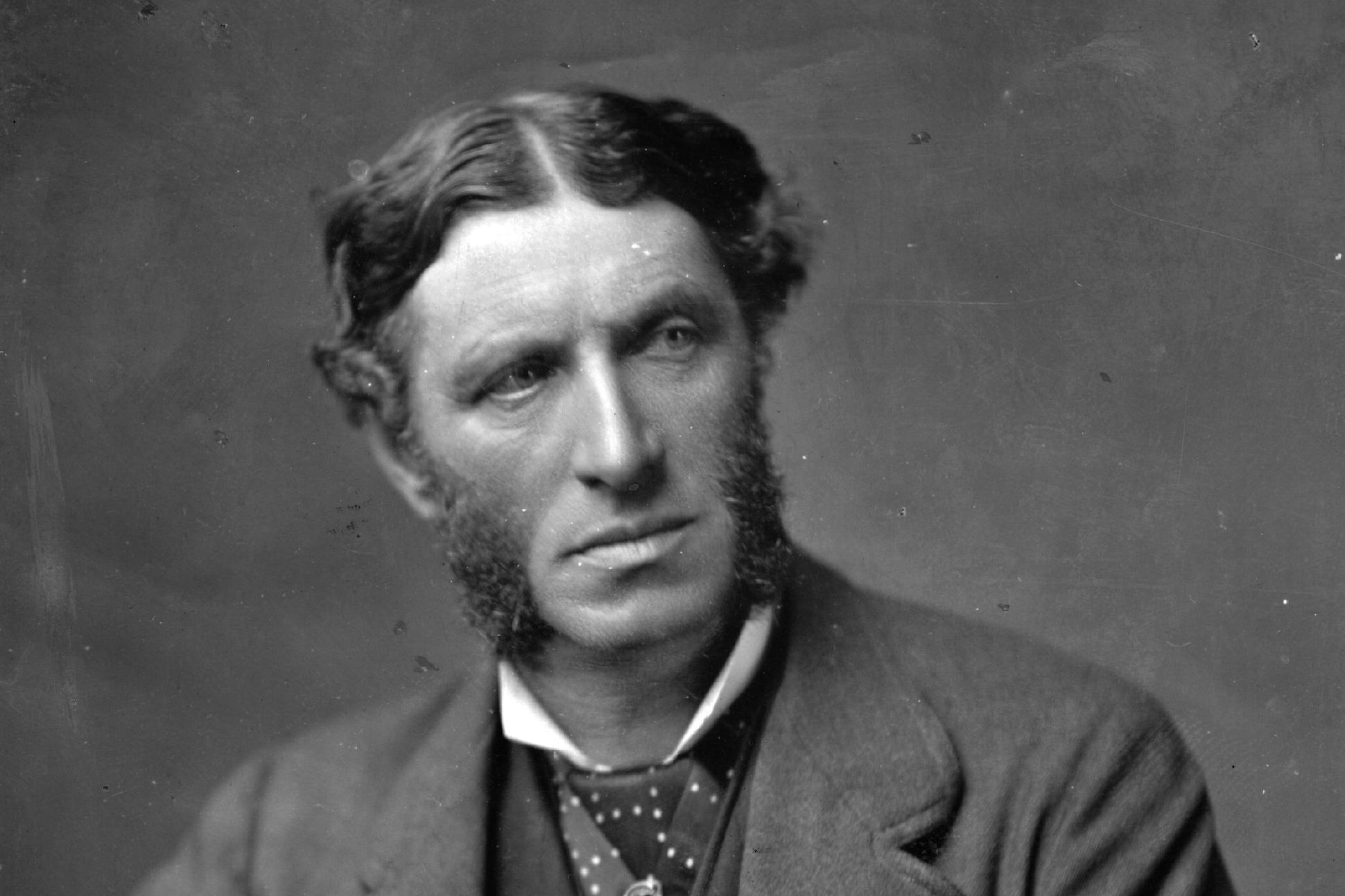
Williams traced the origins of the word “culture” to the Latin term colere, meaning “to cultivate” or “to grow.” Initially, this referred to agricultural practices, such as tending to crops or livestock. Over time, the meaning expanded to include the cultivation of human intellect and the refinement of behavior, tying culture to ideas of education and “progress.” This interpretation influenced thinkers such as Matthew Arnold (1822-1888), who, in the 19th century, defined culture as “the best that has been thought and said in the world.” Arnold’s view equated culture with the pursuit of intellectual and artistic excellence—what he termed “high culture“—as opposed to “low culture,” which he associated with the entertainment and everyday practices of the masses.

This distinction between high and low culture reflects broader societal debates about power, privilege, and value. Arnold’s framework prioritized elite traditions and knowledge, often marginalizing or devaluing the practices of working-class or marginalized groups. By contrast, sociologists and anthropologists in the late 19th and early 20th centuries rejected this hierarchical view, redefining culture as a more inclusive and egalitarian concept. They described culture as the shared beliefs, values, practices, and symbols that characterize any group of people, regardless of social standing. This shift recognized the cultural richness present in all human societies, from artistic masterpieces to everyday rituals and traditions.
Even today, the concept of culture remains multifaceted. It encompasses both tangible elements, such as art, music, and literature, and intangible ones, such as norms, values, and belief systems. It also raises important questions: Is culture primarily a product of individual creativity or collective agreement? Does it remain constant across generations, or is it always evolving? These complexities make culture a rich but challenging subject of sociological inquiry, as it touches on virtually every aspect of human life.
Despite these complexities, sociologists find value in defining culture as a framework for analysis. For the purposes of this course, we will use the following definition: Culture is the set of shared beliefs, values, practices, and symbols that individuals learn and transmit within their social groups, shaping how they interpret and interact with the world around them. This definition emphasizes the dynamic and shared nature of culture, providing a foundation for the discussions and analyses that follow. In the next sections, we will explore how culture shapes human behavior and the structures of society, focusing on its key components: beliefs, values, and practices.
The Building Blocks of Culture: Beliefs, Values, Practices, and Symbols
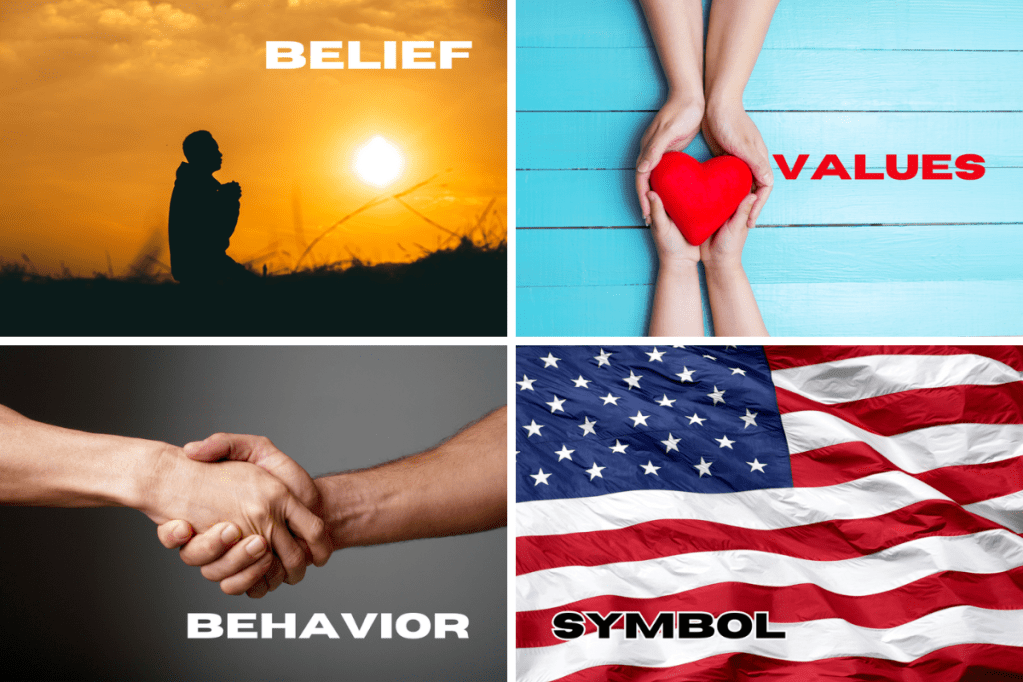
To fully understand the sociological definition of culture, we must examine its core components: beliefs, values, practices, and symbols. These elements work together to shape how individuals and groups interpret and navigate the world, providing the foundation for shared meaning and collective identity.
Beliefs are the ideas that people hold to be true, whether about the natural world, the social world, or the metaphysical. In sociological terms, beliefs do not require objective evidence; they are socially constructed and shaped by the cultural context in which they develop. For example, some cultures believe that individual success is a result of hard work, while others may emphasize the role of community support or spiritual forces. These beliefs guide how people make sense of their experiences and influence their actions. Beliefs are deeply embedded in cultural traditions and often passed down from generation to generation, forming the bedrock of a society’s worldview.
Values, on the other hand, are the moral principles or standards that a society collectively considers desirable, important, or good. While beliefs describe what is true or real, values define what ought to be. For instance, in many societies, values such as freedom, equality, or respect for elders shape the expectations for individual behavior and societal norms. Values are not universal; they vary widely between cultures and can even conflict within the same society. For example, the value of individual achievement may clash with the value of collective harmony in certain contexts. Sociologists study values to understand how they influence social cohesion, conflict, and change.
Behaviors are the habitual actions and practices that people engage in as they live out their beliefs and values. These include rituals, customs, and everyday routines that reflect and reinforce the cultural framework of a society. For example, religious ceremonies, such as attending church services or observing Ramadan, are practices rooted in shared beliefs and values. Similarly, mundane activities like greeting someone with a handshake or bow are cultural practices that communicate respect or familiarity. Through practices, culture becomes visible and tangible, as it is enacted and reaffirmed in daily life.
Finally, symbols are the objects, gestures, sounds, or images that carry specific meanings within a culture. Symbols are powerful because they allow individuals to communicate complex ideas and emotions without words. Consider the significance of national flags, religious icons, or even everyday emojis. Each of these symbols represents something larger than itself, evoking shared understandings and emotional connections. Symbols are not static; their meanings can change over time as cultures evolve. For example, a raised fist has been used historically as a symbol of solidarity and resistance, taking on different connotations depending on the social movements it represents.
Together, beliefs, values, practices, and symbols form the scaffolding of culture, creating a shared framework through which people understand their world and their place within it. These elements are deeply interconnected: beliefs and values shape practices, while symbols give meaning to all three. By studying these components, sociologists can uncover the underlying patterns that structure human behavior and social organization. In the sections ahead, we will explore these elements further, examining how they interact and influence the ways we think, act, and relate to one another.
Types of Culture: Material, Non-Material, Sub-Cultures, and Countercultures
Culture, as we’ve seen, is a complex concept made up of beliefs, values, practices, and symbols. But culture is not a single, monolithic entity. It manifests in different forms and operates on multiple levels within society. Sociologists often differentiate between two broad types of culture—material and non-material—and examine the diverse cultural expressions found in subcultures and countercultures.
Material Culture and Non-Material Culture

Material culture refers to the tangible, physical objects that people create and use within a society. These objects include everything from tools, clothing, and buildings to technology and artwork. Material culture reflects a society’s technological advancements and artistic achievements, offering a visible representation of its values and beliefs. For example, smartphones are a part of modern material culture. They symbolize technological progress and often reflect broader cultural values, such as efficiency, connectivity, and convenience.

In contrast, non-material culture encompasses the intangible aspects of culture, such as beliefs, values, norms, and symbols. While material culture focuses on what a society produces, non-material culture shapes how people think, behave, and interpret the world. For instance, the belief in individual freedom, the value of equality, and the norm of saying “please” and “thank you” in conversation are all elements of non-material culture. These intangible aspects influence how people use and interact with material objects. For example, the widespread use of smartphones is tied to non-material cultural values like productivity and social interaction.
Although material and non-material culture are distinct, they are deeply interconnected. Material objects often carry symbolic meanings rooted in non-material culture. A national flag, for example, is a physical object (material culture) but represents patriotism, identity, and collective memory (non-material culture).
Subcultures and Countercultures
Within any society, culture is rarely uniform. Instead, it exists in layers, with subcultures and countercultures offering alternative or oppositional expressions of shared cultural norms and values.

A subculture is a smaller cultural group within a larger society that shares its own distinct beliefs, values, and practices. Subcultures often emerge around shared interests, experiences, or identities, but they generally coexist peacefully within the broader culture. For example, the skateboarding community is a subculture characterized by its own style of dress, slang, and values, such as creativity and independence. Subcultures add diversity to society by providing spaces for people to express their unique identities while still participating in the larger cultural framework.

A counterculture, on the other hand, actively rejects and opposes the dominant culture’s values and norms. Countercultures often emerge as a form of resistance, challenging societal power structures or advocating for alternative ways of living. For example, the hippie movement of the 1960s was a counterculture that rejected mainstream values of materialism and conformity, instead promoting peace, love, and environmental consciousness. While subcultures coexist with the dominant culture, countercultures often seek to disrupt or transform it.
Both subcultures and countercultures highlight the diversity within societies and the dynamic nature of culture itself. Subcultures can serve as creative spaces for innovation and self-expression, while countercultures can drive social change by challenging the status quo.
Social Norms: The Rules of Culture
Culture is not only about beliefs, values, practices, and symbols—it is also about the rules that guide how we interact with one another. These rules, known as social norms, are the expectations a society holds for behavior in different situations. Social norms are an integral part of culture because they provide structure and predictability, helping people navigate their social worlds. They tell us how to act, what to say, and even how to think in certain contexts, reinforcing the shared values and beliefs that bind a society together.
At their core, social norms are collective agreements about what is acceptable or unacceptable behavior. For example, greeting someone with a handshake in the United States is a widely understood norm for politeness in formal settings. Similarly, avoiding speaking loudly in a library is a norm that reflects shared respect for quiet spaces. These norms, although often unwritten, are powerful because they shape behavior, reinforcing cultural cohesion and preventing social chaos. Yet, not all norms are the same—some are mild suggestions for behavior, while others carry significant moral or legal weight.
Sociologists distinguish between different types of social norms based on their importance and the consequences of violating them: folkways, mores, taboos, and laws.

Folkways
Folkways are the everyday customs that govern routine interactions. They are the least strict type of social norm and are often based on traditions or cultural habits. Violating a folkway typically does not result in serious consequences, though it may lead to minor social disapproval. For instance, eating with your hands at a formal dinner or wearing mismatched socks might draw raised eyebrows, but these behaviors do not threaten the moral fabric of society. Folkways help maintain a sense of normalcy and politeness in daily life but are more about social preferences than moral imperatives.
Mores
Mores (pronounced “mor-ays”) are norms that carry a greater moral significance and are closely tied to a society’s core values. Violating mores is seen as a challenge to the social order and often provokes stronger reactions than breaking a folkway. For example, lying, cheating, or disrespecting elders may be viewed as violations of mores, as these actions undermine the values of honesty, trust, and respect that many societies hold dear. While mores may not always be codified into law, they are powerful social expectations that reinforce what is considered morally right or wrong.
Taboos
Taboos represent the strongest form of social norms and prohibit behaviors that are deeply offensive or unthinkable within a society. Violating a taboo often results in severe social, and sometimes legal, consequences, as these actions are considered morally reprehensible. For instance, acts like incest or cannibalism are taboo in most cultures because they violate fundamental ethical principles and provoke intense disgust. Taboos are universal in their seriousness but vary widely between societies, reflecting cultural differences in what is considered unacceptable.
Laws
Laws are formalized norms that are written and enforced by governments or legal authorities. Unlike folkways, mores, or taboos, laws are explicitly stated and carry specific punishments for violations. For example, driving under the influence or stealing is illegal in most societies, and breaking these laws results in legal consequences like fines or imprisonment. Laws often overlap with mores, as they protect core societal values, but they differ in being institutionalized and enforced through formal systems.
Together, these types of social norms create a layered framework that shapes human behavior and reflects the shared values of a culture. Folkways, mores, taboos, and laws highlight the diversity of cultural expectations and the varying levels of importance societies place on different behaviors. Understanding these norms allows sociologists to analyze how culture guides social interactions and maintains order within communities.
Cultural Change: The Evolution of Culture
Although culture often appears stable, it is inherently dynamic, constantly adapting to new ideas, technologies, and social interactions. Sociologists study cultural change to understand how societies evolve and respond to both internal innovations and external influences. These changes can be slow and subtle, such as shifts in social attitudes, or rapid and transformative, like the widespread adoption of the internet.
Cultural change often begins with innovation, the creation of new ideas, tools, or practices that alter how people live and interact. For instance, the invention of smartphones revolutionized communication, reshaping everything from personal relationships to how businesses operate. Yet, innovation rarely happens in isolation. It is frequently accompanied by cultural diffusion, the spread of cultural elements—such as beliefs, practices, or technologies—between groups. This exchange has accelerated in the modern world through trade, migration, and global media, blending traditions and creating new cultural hybrids. For example, cuisines like sushi or tacos have become global phenomena, evolving beyond their origins while still maintaining their cultural significance.
Prolonged interaction between different cultures can also lead to acculturation, a blending of cultural practices and ideas. In the United States, genres like jazz and hip-hop are prime examples of cultural blending, combining African, European, and American influences to create something entirely new. However, cultural change is not always harmonious. The concept of cultural lag highlights how material culture, such as technological advancements, often changes faster than non-material culture, like ethical beliefs or social norms. For instance, debates over the ethical use of genetic editing technologies reveal how societies struggle to adapt to new realities.
Cultural change often inspires both excitement and resistance. Some view change as progress, embracing new possibilities for freedom or equality, while others fear the loss of tradition or stability. This tension is especially visible in debates about climate change policies, evolving gender roles, or the rapid influence of social media. Furthermore, the speed and scope of cultural change are not uniform; urban areas with greater exposure to global influences often adapt more quickly than rural regions, creating cultural divides within societies.
By studying cultural change, sociologists uncover how societies navigate challenges, adapt to innovation, and integrate new ideas. These processes reveal not only how culture evolves but also how it shapes the future of human interaction and societal organization.
Cultural Stress Points: Power, Conflict, and Change

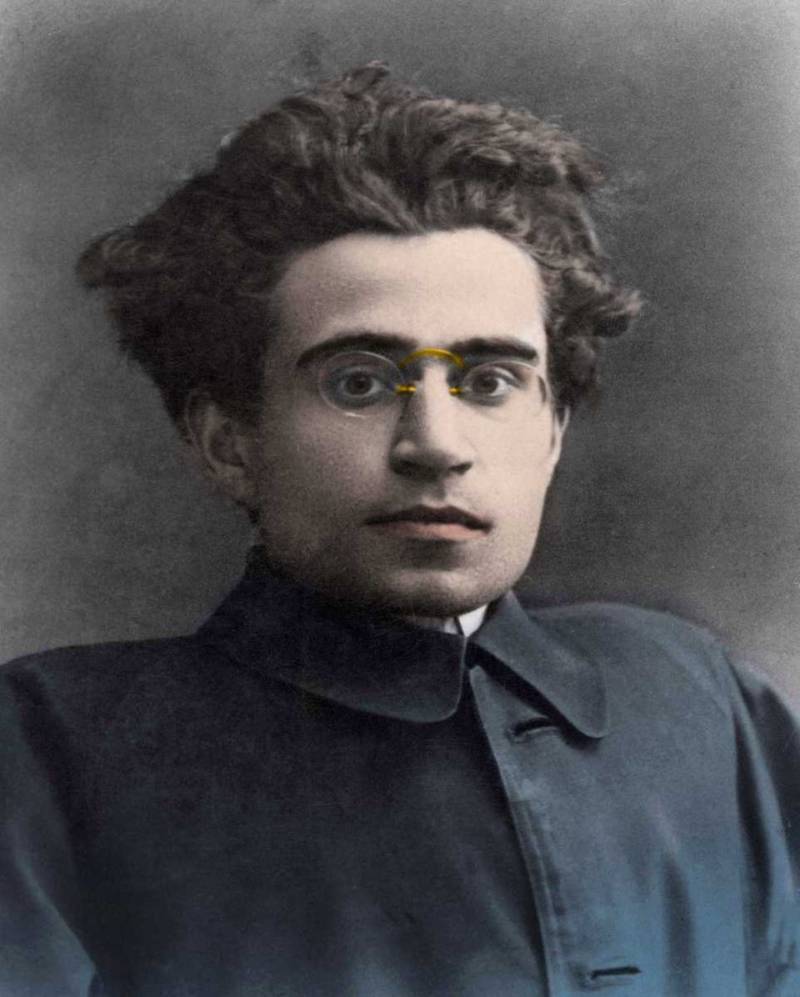
At the heart of cultural stress points lies the concept of cultural hegemony, developed by the Italian Marxist sociologist and philosopher Antonio Gramsci (1891-1937). Cultural hegemony refers to the way dominant groups in society maintain their power not just through force or coercion but by shaping cultural norms, values, and beliefs to align with their interests. This process makes the dominant group’s worldview appear natural, inevitable, and beneficial for everyone, even when it primarily serves their own power and privilege. Gramsci’s insight was revolutionary because it revealed how power operates subtly, through consent rather than overt oppression.
Consider, for example, the widespread cultural emphasis on consumerism in many modern societies. Advertisements, media, and social norms frequently reinforce the idea that happiness and success are tied to material wealth—owning the latest smartphone, driving a luxury car, or wearing designer clothing. These messages are so pervasive that they shape our desires and choices, often without us questioning their origins or implications. Consumerism becomes normalized, a “common sense” approach to life, even though it benefits corporations and economic elites far more than the average consumer. This is cultural hegemony in action: it convinces people to participate in and perpetuate systems that uphold existing power structures.

One striking example of this normalization is the rise of Black Friday as an unofficial “holiday” dedicated to shopping. The day after Thanksgiving, retailers flood the market with advertisements and promotions, encouraging people to begin their holiday spending. Black Friday has become so embedded in U.S. culture that it often overshadows the holiday it follows, with some stores opening their doors on Thanksgiving Day itself. Beyond Black Friday, nearly every major holiday—from Valentine’s Day to Christmas—is accompanied by sales campaigns urging consumption, reinforcing the idea that celebrating and spending are inseparable. While these practices drive corporate profits, they contribute to a consumer culture that leaves many individuals burdened with debt. As of late 2024, the average American household carries over $104,000 in debt, much of it tied to spending habits cultivated by this consumerist ethos. This is cultural hegemony in action: it convinces people to participate in and perpetuate systems that uphold existing power structures.
Importantly, Gramsci also argued that cultural hegemony is not unshakable. Dominant ideologies are always being contested, especially by those who are marginalized or oppressed. Resistance often begins within culture itself, as alternative ideas and values challenge the status quo. For instance, environmental movements question the cultural norms of consumerism and advocate for sustainability over profit. These movements aim to reshape societal values, challenging the hegemonic belief that economic growth must always come at the expense of the environment.
Gramsci’s concept of cultural hegemony provides a powerful lens for understanding how cultural stress points emerge. When dominant cultural narratives are contested, society experiences tension and conflict. These moments of resistance expose the fragility of hegemony, illustrating that power is never absolute but always negotiated. This dynamic is at the heart of the culture wars and the broader struggles over identity, morality, and the future of society.
The Culture Wars: Battling Over Values and Norms

The culture wars refer to the ideological and moral conflicts that have shaped the late 20th and 21st centuries, particularly in the United States. These battles center on deeply held beliefs about identity, morality, and the direction of society, often dividing people along political, religious, and generational lines. Unlike economic debates, which focus on material resources, culture wars revolve around symbolic issues that reflect competing visions of what society should value.
The term gained prominence in the 1980s and 1990s, largely through the work of sociologist James Davison Hunter, who described these conflicts as a clash between two broad cultural factions. On one side were the progressives, who advocated for expanding rights, challenging traditional hierarchies, and redefining social norms to promote inclusivity. On the other side were the traditionalists, who sought to preserve long-standing cultural and moral values, often rooted in religious or historical traditions.
Prominent figures, or “culture warriors,” have played key roles in shaping and intensifying these debates. For example, conservative figures like Pat Buchanan and Jerry Falwell rallied against issues such as abortion, LGBTQ+ (Lesbian, Gay, Bisexual, Transgender, Queer (or Questioning), and others) rights, and secularism, portraying these as threats to America’s moral fabric. On the progressive side, activists like Gloria Steinem and Harvey Milk championed feminist and LGBTQ+ causes, advocating for equality and challenging traditional power structures. These individuals symbolized broader societal divisions, turning cultural debates into national controversies.
The culture wars were initially tied to issues like abortion, school prayer, and censorship of art and media. Over time, they expanded to include a broader range of cultural stress points that continue to dominate public discourse and policy debates today.
Examples of Cultural Stress Points
The cultural stress points listed below illustrate how the culture wars have evolved, exposing deeply rooted tensions within society. Each example reveals the clash between competing values and the broader societal implications of these conflicts.
School Curriculum
The debate over school curriculum lies at the heart of the culture wars, as it reflects the struggle to shape the values and knowledge imparted to the next generation. Controversies surrounding critical race theory, sex education, and the inclusion of diverse historical narratives have sparked heated disagreements. Advocates for inclusive curricula argue that students must learn about systemic racism, gender diversity, and global perspectives to understand modern society. Opponents, however, view these additions as divisive or as attempts to indoctrinate children, preferring curricula that emphasize national pride and traditional values. These debates often escalate in school board meetings and legislative battles, showcasing the deep divisions over identity and morality.
LGBTQ+ Rights
LGBTQ+ rights have long been a central issue in the culture wars, encompassing debates over same-sex marriage, transgender inclusion, and the recognition of non-binary identities. Supporters of LGBTQ+ rights argue that equality and representation are essential for human dignity, pointing to progress such as the legalization of same-sex marriage in the 2015 Supreme Court case, Obergefell v. Hodges, as milestones in civil rights. Critics, however, often cite religious or cultural objections, opposing policies like gender-affirming healthcare or inclusive education. High-profile debates, such as the controversy over transgender athletes in sports, illustrate how these conflicts intersect with broader discussions about fairness, identity, and societal norms.
Climate Change
Climate change has become a cultural stress point that extends far beyond environmental policy, reflecting fundamental differences in worldview. Advocates for immediate action argue that addressing global warming is a moral imperative, citing scientific consensus and the potential catastrophic impacts of inaction. Detractors often question the severity of the crisis or prioritize economic growth over environmental regulations, seeing climate policies as costly and restrictive. Public figures like Greta Thunberg have energized global youth movements demanding action, while skeptics, including some political leaders, downplay the urgency. These debates reveal tensions between long-term sustainability and short-term priorities.
Gun Control
The issue of gun control epitomizes the divide between individual freedoms and collective safety. Supporters of stricter gun regulations highlight the alarming rates of gun violence and mass shootings, arguing that policies like universal background checks or bans on assault weapons are necessary for public safety. Opponents frame gun ownership as a fundamental right protected by the Second Amendment, associating firearms with personal liberty and self-defense. High-profile incidents, such as school shootings, fuel the debate, with organizations like the NRA (National Rifle Association) advocating against regulation and grassroots movements like March for Our Lives demanding reform. The intensity of this issue reflects its deep cultural and constitutional roots.
Abortion
Abortion remains one of the most enduring and contentious cultural stress points, reflecting opposing views on morality, autonomy, and religion. The landmark Supreme Court decision in Roe v. Wade (1973) legalized abortion nationwide, sparking decades of activism on both sides. Pro-choice advocates emphasize the importance of bodily autonomy and access to healthcare, while pro-life groups frame abortion as the taking of human life, often grounded in religious beliefs. The overturning of Roe in 2022 in Dobbs v. Jackson Women’s Health Organization (2022) reignited these debates, leading to state-level battles and intensifying the cultural divide.
Crime and Policing
Debates about crime and policing tap into deep fears and anxieties, making this issue a potent cultural stress point. Movements like Black Lives Matter have brought attention to systemic racism in law enforcement and the need for police accountability, particularly in the wake of high-profile incidents of police brutality. Critics of these movements often frame them as anti-police, advocating instead for stronger law enforcement to address rising crime rates. This divide reveals broader concerns about safety, justice, and trust in public institutions, with both sides often talking past one another rather than finding common ground.
Free Speech
The question of free speech, particularly in the age of social media, underscores tensions between individual expression and societal boundaries. On one side, advocates argue that free speech is essential to democracy, warning against “cancel culture” and censorship. On the other side, critics point to the dangers of hate speech, misinformation, and harassment, calling for stricter regulations to protect marginalized groups and public discourse. High-profile cases involving deplatformed public figures or controversial speakers on college campuses illustrate how this debate continues to evolve, challenging traditional understandings of free expression.
Cultural Appropriation
Cultural appropriation refers to the adoption of elements from one culture by members of another, often without understanding or respect for their original context. This becomes a cultural stress point when members of a dominant culture adopt aspects of marginalized cultures, such as traditional clothing or hairstyles, in ways that commodify or misrepresent them. For example, controversies over the use of Native American headdresses at festivals illustrate the tensions between cultural appreciation and exploitation, sparking debates about identity and respect.
Sociological Perspectives in Action: Yale’s 2014 Fight Over Halloween Costumes
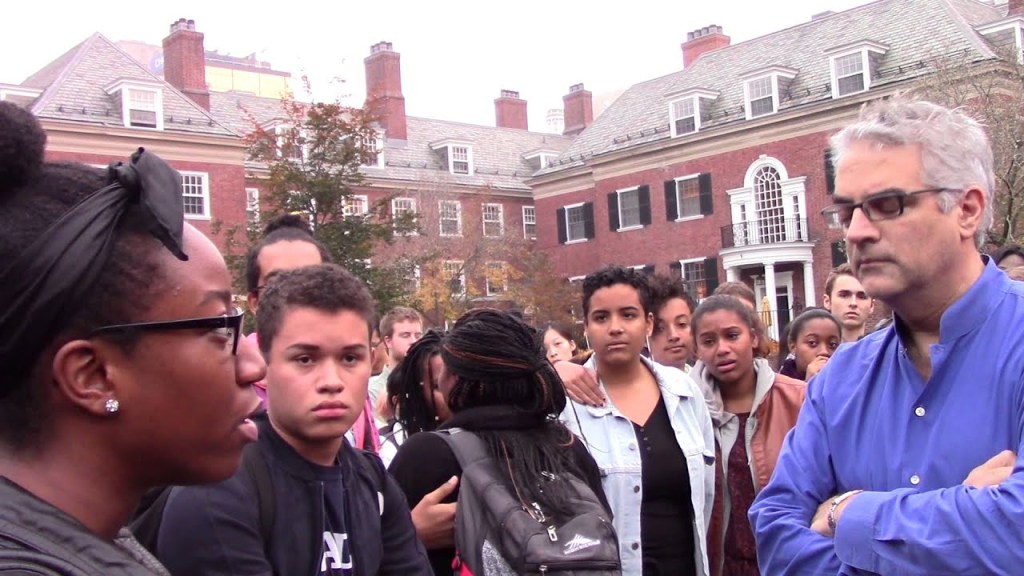
In 2014, Yale University became a flashpoint for a national debate on cultural sensitivity, free speech, and the boundaries of expression. The controversy began when the university’s Intercultural Affairs Council sent an email urging students to consider the cultural implications of their Halloween costumes and to avoid outfits that could be seen as offensive or appropriative—such as those that caricature racial, cultural, or gender identities. Shortly after, Erika Christakis, a faculty member and residential college administrator, responded with her own email, questioning whether the university should police costume choices or allow students the freedom to make their own decisions, even if it meant tolerating poor judgment. (See link for more)
Christakis’s email sparked a fierce backlash, with many students arguing that it dismissed the harm caused by costumes rooted in stereotypes and cultural mockery. Protests erupted on campus, with students calling for greater accountability and sensitivity from faculty and administrators. Others defended Christakis’s stance as a defense of free expression and individual autonomy. The debate quickly gained national attention, reflecting broader cultural tensions over identity, inclusion, and the limits of personal freedom.
To better understand this controversy, sociologists might analyze it through three major theoretical perspectives that were introduced in Module 03: Symbolic Interactionism, Structural-Functionalism, and Conflict Theory. Each lens provides a unique way of interpreting the events at Yale, from the micro-level dynamics of interpersonal interactions to the macro-level struggles over power and social change. As you read this analysis, consider how these perspectives shape the questions we ask and the insights we gain about such cultural phenomena. By the end of this course, you’ll be using these same tools to analyze the pressing issues of our time.
Symbolic Interactionism
From the symbolic interactionist perspective, Halloween costumes are more than just clothing—they are symbols that convey meanings and social messages. A sociologist using this lens might explore how certain costumes, like those depicting cultural stereotypes, are interpreted by different groups. For example, what does it mean when someone wears a costume that caricatures a marginalized culture? How does that act shape the perceptions of those who belong to the culture being represented? Interactionists would also examine how these costumes influence social interactions, such as how they might provoke feelings of exclusion, offense, or solidarity among students. The controversy itself becomes a space where meanings are debated, negotiated, and redefined through the dialogues and protests on campus.
Structural-Functionalism
A functionalist approach would frame this controversy within the broader question of how universities maintain social order and shared norms. Institutions like Yale have historically been tasked with educating students and fostering a sense of community. A functionalist might ask: What purpose do policies around costumes serve in maintaining harmony on campus? Are these debates signs of a system in crisis, or are they a natural way for societies to evolve shared values? Halloween costumes that mock cultures could be viewed as disruptive to the university’s mission of inclusivity and education, threatening the cohesion of a diverse student body. Conversely, the backlash and resulting dialogue might be seen as a way for society to adapt and renegotiate norms to better support marginalized groups.
Conflict Theory
Conflict theorists would analyze the costume controversy as a reflection of broader power dynamics and inequalities. They might ask: Who has the power to define what is “offensive” or “acceptable”? The debate could be seen as a clash between dominant groups defending their freedom of expression and marginalized groups fighting for recognition and respect. Costumes that appropriate or mock marginalized cultures could be interpreted as an assertion of dominance, reinforcing existing social hierarchies. The email questioning restrictions on costumes might be viewed as prioritizing the interests of those in privileged positions, while protests and calls for policy changes represent efforts to redistribute power and challenge the status quo.
Deeper Structural Debates in Culture
While the examples of cultural stress points we’ve explored—ranging from school curricula to cultural appropriation—are highly relevant to today’s society, they are often shaped by deeper, long-standing debates about the nature of culture itself. These debates influence how societies define their values, navigate diversity, and address conflict. At the heart of these discussions lie fundamental questions about how cultures should be understood, preserved, or transformed. Three of the most significant of these structural debates are the tension between ethnocentrism and cultural relativism, and the debate between assimilation and multiculturalism.
Ethnocentrism vs. Cultural Relativism
Ethnocentrism is the tendency to view one’s own culture as superior and to judge other cultures by the standards and values of one’s own. It is a deeply ingrained perspective that shapes how individuals and groups interpret cultural differences. Ethnocentrism often leads to stereotyping, prejudice, and even hostility toward those perceived as “other,” as it assumes that one cultural framework is the “correct” way of living. For example, debates about certain cultural practices—such as arranged marriages or religious dress codes—are often framed in ethnocentric terms, with outsiders dismissing these traditions as backward or oppressive without understanding their cultural significance.
In contrast, cultural relativism emphasizes understanding cultures on their own terms, without imposing external judgments. This perspective encourages empathy and an appreciation for cultural diversity by recognizing that practices and beliefs are shaped by unique historical, social, and environmental contexts. For example, a cultural relativist approach to arranged marriages might involve studying how these practices function within specific societies, considering factors such as family structure and social cohesion.
The tension between these two perspectives is profound because it shapes how societies engage with differences. Ethnocentrism can foster unity within a dominant culture but often at the expense of marginalizing or devaluing others. Cultural relativism, while promoting inclusivity and understanding, raises questions about whether there are universal moral standards that transcend cultural boundaries. For instance, should practices like female genital mutilation or child labor be condemned outright, or should they be understood within their cultural contexts? These debates reveal the complexities of balancing respect for cultural diversity with a commitment to universal human rights.
In the context of the United States, the debate between ethnocentrism and cultural relativism is particularly salient. As a multicultural society, the U.S. often grapples with questions about how to celebrate diversity while maintaining a sense of national identity. Ethnocentric perspectives can lead to exclusionary policies, such as English-only laws or resistance to cultural accommodation, while cultural relativism supports efforts to recognize and embrace the contributions of all cultural groups. This tension underpins many of the cultural stress points we have explored, influencing debates over immigration, free speech, and education.
Assimilation vs. Multiculturalism: Balancing Unity and Diversity
As societies grow increasingly diverse, they face the ongoing challenge of managing cultural differences and fostering coexistence. In the United States, this challenge has been framed through the debate between assimilation and multiculturalism, two approaches that reflect differing visions of how cultural diversity should be handled. These perspectives not only shape national policies but also influence cultural identities, public debates, and stress points.
Assimilation refers to the process by which individuals or groups from different cultural backgrounds adopt the norms, values, and practices of the dominant culture, often in pursuit of social acceptance or integration. Historically, assimilation was a cornerstone of American identity, encapsulated in the metaphor of the “melting pot,” where immigrants were expected to blend into a unified national culture. Policies promoting assimilation included the establishment of English-only education, pressure to abandon native languages, and the celebration of distinctly American holidays. Proponents argue that assimilation fosters social cohesion and national unity, reducing cultural divisions by encouraging shared values and practices.
However, assimilation also has its critics, who argue that it often erases cultural identities, marginalizes minority groups, and reinforces power imbalances. In the 21st century, these critiques have become particularly salient as immigrant populations, particularly from Latin America and Asia, have grown. Debates over policies such as English-only laws, the pledge of allegiance in schools, and the celebration of non-Christian holidays illustrate how assimilation can generate cultural stress points in a society that is becoming more diverse than ever.
Multiculturalism, by contrast, advocates for the coexistence of multiple cultural identities within a single society, emphasizing the value of diversity. Rather than expecting cultural groups to conform to a dominant standard, multiculturalism promotes respect for cultural differences and encourages the preservation of unique traditions and languages. Policies reflecting multiculturalism might include bilingual education, legal protections for minority cultural practices, and public celebrations of diverse heritages, such as Hispanic Heritage Month or Lunar New Year festivities. The “salad bowl” metaphor, which suggests that diverse cultures can coexist without losing their unique identities, has increasingly supplanted the melting pot ideal in American discourse.
In the 21st century, multiculturalism remains a contentious issue. Supporters argue that it enriches society by fostering inclusivity, creativity, and mutual understanding. However, critics, often from conservative perspectives, contend that multiculturalism risks fragmenting national identity, promoting division instead of unity. For example, debates over immigration policies frequently center on whether newcomers should assimilate to “American” values or whether their cultural traditions should be accommodated and celebrated. Controversies over bilingual education and the recognition of non-Christian holidays also highlight the ongoing tension between these approaches.
The rise of social media and globalization has further complicated the debate. Multiculturalism has gained visibility and support through platforms that amplify diverse voices and celebrate cultural expressions. At the same time, these platforms have also heightened backlash from those who see assimilation as essential to maintaining shared values and societal cohesion. These debates reflect a fundamental question: should cultural differences be minimized to create unity, or embraced as a strength that defines modern America?
The tension between assimilation and multiculturalism in the United States reflects larger questions about what it means to belong in a diverse society. While assimilation prioritizes unity and shared identity, multiculturalism emphasizes inclusion and respect for differences. These debates are unlikely to subside as the U.S. continues to grapple with its role as a nation of immigrants and its commitment to equality and diversity in an increasingly interconnected world.
Conclusion
Culture is far more than a collection of traditions or a reflection of artistic achievements—it is the framework through which individuals and societies interpret the world. From beliefs and values to practices and symbols, culture shapes our identities and interactions while reflecting the complexities of human existence. As we’ve explored, the concept of culture is not static; it evolves through innovation, diffusion, and contestation, revealing the dynamism of social life. Whether through the debates over assimilation versus multiculturalism, the role of consumerism, or the pressures of cultural hegemony, culture serves as both a battleground for conflict and a foundation for connection.
Ultimately, studying culture offers us more than just an academic exercise—it provides a lens to critically analyze the forces that unite and divide us. It invites us to ask: How can we navigate these complexities to create societies that are not only cohesive but also inclusive? As we continue to explore culture’s many facets, these questions remain essential for understanding both the present and the possibilities for the future.
Key Terms
Acculturation: The blending of cultural practices and ideas between groups, often resulting in a combination of elements from different traditions.
- Example: Jazz music, which combines African, European, and American influences, is an example of acculturation.
Assimilation: The process by which individuals or groups adopt the norms, values, and practices of a dominant culture, often at the expense of their original cultural identity.
- Example: Immigrants learning and using only English while abandoning their native language reflects assimilation.
Beliefs: The ideas that people hold to be true, shaped by their cultural context and passed down through generations.
- Example: The belief that hard work leads to success in the United States reflects a cultural value.
Behaviors: The habitual actions and activities that people engage in based on their cultural norms, values, and beliefs.
- Example: Greeting someone with a handshake in the U.S. is a culturally influenced behavior.
Counterculture: A cultural group that actively rejects and opposes the dominant culture’s values and norms.
- Example: The 1960s hippie movement, which promoted peace and environmentalism over materialism and conformity.
Cultural Diffusion: The spread of cultural elements, such as ideas, practices, or technologies, between groups.
- Example: The global popularity of sushi as a cuisine outside of Japan illustrates cultural diffusion.
Cultural Hegemony: The way dominant groups maintain power by shaping cultural norms, values, and beliefs to align with their interests.
- Example: Consumerism, promoted through media and advertising, benefits corporations while shaping societal values.
Cultural Lag: The delay in adapting non-material culture, like ethical beliefs or social norms, to changes in material culture or technology.
- Example: The ethical debates surrounding genetic editing technologies reflect cultural lag.
Cultural Relativism: The perspective that cultures should be understood on their own terms, without imposing external judgments.
- Example: Understanding arranged marriages in terms of their role in specific cultural contexts, rather than judging them by Western norms.
Culture: The set of shared beliefs, values, practices, and symbols that individuals learn and transmit within their social groups.
- Example: A society’s traditions, language, and art all contribute to its unique culture.
Culture Wars: Ideological and moral conflicts over values and norms within a society, often dividing groups along political, religious, or generational lines.
- Example: Debates over school curricula, such as the inclusion of critical race theory or sex education.
Ethnocentrism: The tendency to view one’s own culture as superior and to judge other cultures by one’s own standards.
- Example: Criticizing arranged marriages as “backward” without understanding their cultural context.
Folkways: Everyday customs that govern routine interactions, with mild social disapproval for violations.
- Example: Eating with your hands at a formal dinner may violate folkways in many cultures.
Innovation: The creation of new ideas, tools, or practices that alter how people live and interact.
- Example: The invention of smartphones revolutionized global communication and daily life.
Laws: Formalized social norms that are written and enforced by governments or legal authorities.
- Example: Laws against theft ensure the protection of personal property.
Material Culture: The tangible, physical objects created and used within a society.
- Example: Smartphones are part of modern material culture, reflecting values of efficiency and connectivity.
Mores: Norms with significant moral importance, often tied to a society’s core values, with stronger reactions to violations.
- Example: Lying or disrespecting elders is seen as a violation of mores in many cultures.
Multiculturalism: An approach that values the coexistence of multiple cultural identities within a single society.
- Example: Public celebrations like Hispanic Heritage Month emphasize multiculturalism.
Non-Material Culture: The intangible aspects of culture, such as beliefs, values, norms, and symbols.
- Example: The belief in freedom and equality reflects non-material culture.
Social Norms: The unwritten rules that guide behavior in society, creating predictability in social interactions.
- Example: Waiting in line for your turn is a widely understood social norm.
Subculture: A smaller cultural group within a larger society, with its own distinct beliefs, values, and practices.
- Example: Skateboarding communities form a subculture with unique styles and norms.
Symbols: Objects, gestures, sounds, or images that carry specific meanings within a culture.
- Example: A national flag symbolizes identity, patriotism, and collective memory.
Taboos: Strongly prohibited behaviors that provoke severe social and moral consequences when violated.
- Example: Incest and cannibalism are considered taboo in most cultures.
Values: The moral principles or standards that a society considers desirable, important, or good.
- Example: Many societies value freedom and equality as guiding principles.
Reflection Questions
- What is the difference between a subculture and a counterculture, and how do each challenge or reinforce the dominant culture in different ways?
- How does the concept of cultural change help us understand how traditions, beliefs, or behaviors shift over time within a society?
- How does Antonio Gramsci’s idea of cultural hegemony explain the relationship between culture and power, and why might people accept cultural norms that are not in their best interest?
- What does it mean to say that norms and values are socially constructed, and how does this shape our ideas about what is considered right, wrong, normal, or strange?
 The Online Sociologist